I had a number of really interesting meetings this week with some fantastic people. I won’t share all my notes with you because, well, partly it won’t all be interesting or relevant, but also, then I won’t have anything left to reveal in my final report will I. Of course I will, as I need to synthesise these ramblings and understand what it all means. What are the themes, the consistencies, the inconsistencies, the opportunities. Anyway – here are some quotes, some ideas and and some reflections from Massachusetts and beyond.

Everyone I have been speaking to I feel on the same ‘page’ with, we all have fundamentally the same desires and wishes for our work and for the young people we try to support. We want systems and individuals to think about what kids go through, live through, what their parents live through, and to believe that we all do the best we can with what we’ve got. That we can all do better when we have more of what helps – connection, safety, healthy relationships, people who love and care about us. But, as with so many aspects of health care, education systems etc there is always a tension of what to call these approaches, who should be funded to deliver them, where does responsibility belong and who ‘owns’ these concepts. Funding models and cycles keep us competitive when we could be collaborative. New terms emerge, fidelity to models gets stretched, concepts get watered down. Several people I met this week expressed a fear I have had for a while, that people may become tired of hearing about ‘trauma informed’, that it becomes wearisome to hear about it, that people say ‘We did that…what is next…‘
So anyway – here are some new terms, ideas, language, researchers I hadn’t heard of that I will try and learn more about:
- Link Kids https://www.umassmed.edu/cttc/cttc-services/link-kid/
- Toll free number you can call which will put you in touch with trauma trained therapists, has cut waiting time in half , basically a centralised referral process which of course relies on having enough therapists who are training in trauma sensitive practices
- Early Relational Health – term coined by David Willis, Centre for the Study of Social Policy https://cssp.org/team/david-willis/ latest language American Association of Paediatrics are picking up – familiar concepts and not bad just another example of ‘new’ language that people can own and get funded can cause confusion and splitting
- Interesting blog posts here https://cssp.org/2022/03/community-resilience-is-foundational-for-early-relational-health/ talking about community resilience and drawing in language of ACEs and the Pair of ACEs tree

I was lucky enough to get invited this week to a subcommittee meeting with people across the US who are interested in trauma informed practice in educational settings – it was a zoom call. I sat in and listened – was great to be able to see BAU and hear what people were speaking about in their day to day work, not a ‘presentation’ of that they do.
Meeting was first of the academic year and centred around reconnecting, sharing insights from recent conference some attended and the release of guidelines on how being anti racist is central to trauma informed care: https://www.nctsn.org/resources/being-anti-racist-is-central-to-trauma-informed-care-principles-of-an-anti-racist-trauma-informed-organization
Key quotes and themes from the meeting:
- Allow people to speak in rough draft – opening welcoming and tone setting for meeting
- Key themes from conference included Secondary traumatic stress amongst workforces and related to this – workforce retention a key issue
- Schools across the US in same position as Australia – incredibly short staffed, staff that are there are exhausted and overwhelmed with demands
- Question from group – where were the people of colour at the conference – why weren’t they the ones actually presenting the research that was about them, several incidences of research group including people of colour, but research being presented by the most senior researcher (one that got to go to the conference) who were white. What can be done in the future to address this – should in abstracts there be a question regarding this – if the topic indicates the presentation is about a certain group, or people of colour – who is going to be representing this group?
- Another question for the group – not necessarily answered, but posited ‘How are we addressing the issue that schools can be damaging systems themselves?’
- Good question
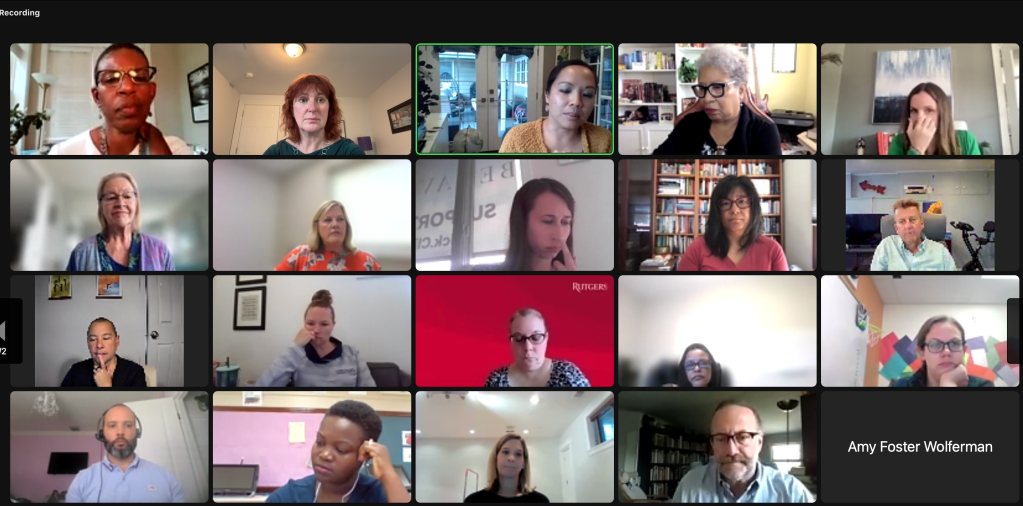
We went into breakout rooms to discuss the new guidelines and connect about where work was at in our areas as people were joining from across the US. One woman in the group was from Wisconsin – she was flat. She seemed tired, defeated even. She said “We have trained over 60,000 educators in Wisconsin in trauma informed practices, but you can still walk into school and they have no idea what trauma informed schooling is’
She said that she felt things had gone backwards over the last 5 years, and that she hears language being used in schools that she hadn’t heard for years.
I asked whether it was the pandemic that had made the difference or something else, at this everyone in the group weighed in – Sure the pandemic had an impact, but the difference was political.
The normalising of hate speech, tearing down of systems and protections, the modelling from government of speaking in hateful ways. The mistrust in systems that has been created by the behaviour of government leading to a massive hit to relational trust.
I shouldn’t have been surprised but I was that the Trump ‘hangover’ is still being felt intensely.
When we came back to the group to share discussion it was very quiet again – unusual I would think with this group that know each other well and are very passionate about what they do. I felt the energy was low, that sense of people being tired at the very beginning of the school year. Which, no doubt they are.
One of the women from my group shared that I had reflected on this, and that we were 3/4 way through our school year, and that it would get better. She said she took hope from that. Is it true? Have things gotten better in Australian schools as the year has gone on? Or did I just say it to make them feel better? I honestly don’t know.


 Nicola's Churchill Adventure
Leave a reply to Narelle Cancel reply